George Osborne’s populist conservatism: insidious, illiberal and regressive

A little after the Budget, Peter Sigrist, one of the organisers of #LibDemPint, tweeted the following:

This led to a long discussion with Peter in which we found little common ground on the measures set out by the Chancellor yesterday. He viewed the Budget, in its entirety, as “relatively balanced“, and even as evidence that “the Lib Dems have had a lasting effect on George Osborne“.

If you hadn’t guessed from the title of this post, I vehemently disagree with Peter’s view. My central point in our discussion was that Osborne’s brilliance involves shifting the political centre to the right, through appropriating previously left-wing policies such as the “living wage” to suit his own ends.

When you consider that Osborne and Cameron gained their initial political colours during the period when Tony Blair was in the ascendant, this becomes unsurprising: they are merely doing what he did, but the other way round, and arguably more successfully.

Of course, they also have it easier, because Blair’s political strategy was based on using market mechanisms to reform public services. In purely economic terms, he didn’t even begin to challenge Thatcherite laissez-faire mores. So when the Tories came to power in 2010, they had little to unravel from that perspective – and they also had the perfect excuse (a massive financial crisis and an unsustainable deficit) to begin to reshape the size and role of the state as they wished.

Now Osborne can take that one stage further without the Liberal Democrats to restrain his more extreme ambitions. His goal is to create a new political economy: one in which the state is no longer involved in attempting to solve material and social inequality of outcome or, indeed, opportunity.

To take a charitable view, we might entertain the idea that he really is committed to a “high wage, low tax, low welfare economy” – but this would be to ignore the reality of the Budget he has just announced. The facts are that the policies announced yesterday achieve neither of the first two concepts:

  • The “high wage” aspect is a smokescreen. No government can raise wages simply by saying so, and the impact of the change is, by confusing the mandate of the Low Pay Commission, to politicise a system that previously worked well. The Office of Budget Responsibility is also clear in its analysis that the “national living wage” will create more unemployment, and will cost the economy money. Given that this is the only policy in the Budget that attempts to create “high wages” – we can chalk it up as a failure.
  • What about low tax? Well, it’s now clear that this Budget is a net revenue raiser, with £25 billion of tax cuts playing off against £47 billion of tax increases. So purely on that alone, he has failed. Moreover, the tax cuts he did announce were focused on the top end of the income and wealth distribution. Obviously the inheritance tax cut only benefits those who are sitting (or more accurately whose parents are sitting) on high-value estates. But the increase to the 40% income tax threshold also only benefits those who earn more than £43,000, while it is understood these days that increases to the basic income tax threshold also disproportionately benefit those on higher incomes.

No, in actual fact, the only portion of Osborne’s mantra that was successfully implemented was the “low welfare” bit. Here, it is true, the Chancellor has delivered in spades. The extent of the cuts and freezes to working-age benefits is breathtaking; more breathtaking still is how they are targeted on the poorest people in society, especially those in low-paid jobs.

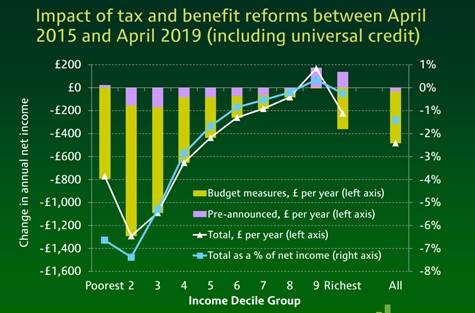
The overall distributional impact analysis was, curiously, left out of the official Budget documents published by the Treasury. This was unusual, as in previous years (including all the years of the Coalition 2010-2015) the Red Book has included charts showing the impact of policy changes on each income decile group. This time, though, it has been left to others to demonstrate the starkly regressive – punitive – effect of George Osborne’s approach. This chart from the IFS speaks volumes:
Impact of tax and benefit reforms

Here you can see not only that the poorest third of the population lose at least £800 per year, but that the ninth richest decile is actually enriched by this Budget.

What’s the point of all this? It’s to show that the Chancellor has entirely failed to deliver a Budget consistent with his own stated aim – a “high wage, low tax, low welfare” economy.

If he were serious about the first bit, he would have used yesterday’s statement to use the proceeds of higher taxation (or even of lower welfare) to put money behind upskilling the workforce. But he didn’t.

If he were serious about the second bit, he wouldn’t have raised an extra £47 billion by disproportionately penalising small businesses through changes to dividend taxation, or by absurdly forcing a carbon tax on companies that buy renewable energy.

The only serious bit was the third bit, and that is because his central political aim is to strip away the support that keeps poor people afloat.

The genius of the Chancellor is to use sweeteners and carefully crafted soundbites to appear reasonable, even centrist. Yesterday was perhaps his most successful attempt yet. Aided and abetted by a supine media and an opposition that isn’t there, he is using the Conservatives’ new political capital to carry forward at a far greater speed his vision for Britain. It is a country gripped by greed, selfishness and suspicion. It is a country where the poorest are expected to fend for themselves and where the wealthiest are enabled and encouraged to hoard their riches.

The most worrying aspect for the Liberal Democrats about all of this is that we are in no position to oppose Osborne. It is only now, after our electoral destruction, that the full scale of our strategic failure in government is becoming apparent.

As Stephen Tall’s excellent but depressing blog today suggests, if our party were still in Coalition, we’d have cheered this Budget.

And, terrifyingly, George Osborne knows it.

What an “unfettered” Tory government might actually mean

A little more than 24 hours after it became painfully clear just what the Conservatives had achieved in the general election, there is already a developing sense of buyer’s remorse. Apparently almost 2400 new members have joined the Liberal Democrats since polls closed. This is obviously a good thing, although perhaps it just reflects the endless propensity of British people to back a plucky underdog.

But it was striking already across both old and new media yesterday how subdued the response to the prospect of five years of majority Tory rule was. There was limited triumphalism from newspapers that had mostly advocated some species of continued coalition or power-sharing arrangement. And the response on Twitter – certainly from people I follow, who are not all Lib Dems by any means – was quite sceptical.

David Cameron, yesterdayPeople are belatedly poring over the Conservative Manifesto to find all the horrors within that might now become a reality. Certainly there are some big, beastly policies that spring out immediately which would never, ever have happened under a continued Tory/Lib Dem arrangement. These include:

  • Abolition of the Human Rights Act

Because we, the people, like governments actively to reduce the number of rights available to us as citizens…

  • £30 billion in further cuts, including £12 billion from welfare – the so-called “rollercoaster” of public spending cuts that will be deeper and more rapid than anything between 2010-2015

Because we, the people, like governments actively to reduce the quality and breadth of public services available to us as citizens on the basis of an arbitrary numerical target…

  • No increases in the vast majority of tax rates

Because we, the people, would rather see the government hack away at vital services than ask us – or our wealthier friends – to pay a bit more to the Treasury…

  • “Abolish” long-term youth unemployment

This is code for the following policies: tougher Day One Work Requirements for jobseekers; introduction of a “Youth Allowance” to replace JSA for 18-21 year olds that forces them to take an apprenticeship, traineeship or do “community work” for their benefits; remove automatic entitlement to Housing Benefit.

Because we, the people, think the best way for new adults to start in life is through a combination of embarrassing and demoralising situations. Work for your benefits and live with your parents into adulthood.

  • Introduce a 50% workforce threshold for strike action, and make it harder for staff in health, education, fire and transport to strike

This will presumably be known as the No Bob Crow Bill. Other policies include the removal of restrictions banning employers from hiring cover during strikes – at a stroke, undermining the whole point of industrial action.

Because we, the people, want our employers to have even more power over us – the balance at the moment is far too much towards us, the bolshy workers.

  • We will give Parliament the opportunity to repeal the Hunting Act on a free vote

Because we, the people, feel this is a sensible use of government and Parliamentary time in the 21st century. And because we like using hounds to kill foxes.

  • We will make EU migrants live here for four years without claiming any benefits

Because we, the people, want to benefit from the presence of people who “work hard and get on” without having to protect them if anything bad happens to them, like if they lose their job – you know, the one a lot of British people wouldn’t want to have to do.

  • “Deport first, appeal later”

This rule will be extended to all immigration appeals and judicial reviews, including where a so-called right to family life is involved. Satellite tracking will also be introduced for every foreign national offender subject to an outstanding deportation order or deportation proceedings.

Because we, the people, care more about getting rid of suspicious-looking foreigners than ensuring they have a right to fair treatment and due process.

  • Introduce new powers to force coasting schools to accept new leadership

Because we, the people, think the best way to make schools better is always to force them to change their leadership. Because problems always start at the top, and nothing can be blamed upon, say, social deprivation or the lack of buy-in from rich parents who can move to be nearer good schools.

  • We will address the unfairness of the current Parliamentary boundaries and reduce the number of MPs to 600

We’ll also introduce “votes for life” for expatriates who live abroad permanently, meaning all those angry people who spend their days on the Costa del Sol, whinging about the country they left, will be able to have an influence on future elections.

Because we, the people, think changes to our electoral system should be left in the hands of whoever won the last election, so that they can make sure the changes made benefit them as a party.

  • We will force Housing Associations to sell their stock at a discount

Extending the Right to Buy to tenants of housing associations? It’s just the beginning. Let’s also extend Help to Buy, give people free money if they’re saving for a deposit, and protect the Green Belt.

We pay lip service to building more bloody houses, but that takes a long time whereas all of these super-popular policies can be done pretty much straight away.

Because we, the people, know that the best way to solve a shortage of a thing is to increase demand for that thing. It’s simple economics.

  • An end to new onshore windfarms

We’ll stop public subsidy for these because they often fail to win public support (but, strikingly, not always).

Because we, the people, like a clear view of our electricity pylons, thank you very much.

  •  We will allow security services to know everything they want to about communications data – the Snoopers’ Charter

And we’ll do “whatever is necessary” to protect the British people.

Because we, the people, are happy for the government to know who we’re talking to, where, when and how. None of that is remotely intrusive as long as they aren’t actually reading the messages themselves.

  • We’ll stop taxing people when they inherit wealth up to £1 million

People should absolutely have the right to have £1 million dropped into their lap without having done a stroke of work to earn it.

Because we, the people, think the best way to make sure everyone in society benefits is to make it easier for aggregated riches to be retained solely by the extremely wealthy.


But does a majority actually mean the Tories will be able to push forward with all of this stuff?

The answer is probably – and hopefully – no. The Conservatives have won a very small majority of 12. That’s worse than John Major’s in 1992, which was 21.

The difficulty of maintaining discipline in such a Parliament cannot be underestimated. But I think it will be worse than it was even for Major. Thanks to the Coalition, the Tory backbenchers from 2010-2015 have had relative freedom to rebel, safe in the knowledge that the majority created by the stability of Conservative/Lib Dem agreement would be sufficient to pass government legislation.

That safety net no longer exists. So what you now have are right-wing Tory backbenchers hungry for red meat – and with a track record of rebellion. The Conservatives’ whipping operation, which was hardly rock solid towards the end of the last Parliament, will become critically important now. The question is whether Michael Gove (the current Chief Whip) or his replacement will be up to the challenge.

On the other hand, these right-wingers will be pulling the party further in the direction of Euroscepticism, spending cuts, and general nastiness. There are few notable exceptions: David Davis, for instance, will continue to fight the good fight on civil liberties, and there might be a small group that joins him. They might be able to get in the way of things like the Communications Data Bill.

But realistically, we should be afraid of what this government is likely to try to do. Against an opposition in disarray, even a strident backbench voice might not be too difficult to quell. Decent people need to mobilise fast against some of the worst aspects of this agenda.