Britain’s doomed NHS is only a symptom of a deeper malaise

My Facebook timeline has, for weeks, been furious at Jeremy Hunt. All this might tell you is that I am friends with the type of people who feel comfortable expressing extreme anger – sometimes hatred – towards politicians. They are mostly middle class, soft left voters, many of whom work in the public sector or have relatives who do so. Several of them work in the NHS, and a couple of them are the very junior doctors at the centre of the maelstrom engulfing the UK’s Health Secretary, who has confirmed his place in the rhyming slang lexicon.

I don’t really intend to add to the debate over the junior doctors’ contract. jeremy_hunt_visiting_the_kaiser_permanente_center_for_total_health_700_second_st_washington_usa-3june2013Hunt is a politician who was shown to be incompetent and cowardly during the BSkyB scandal that, in another age, would certainly have led to resignation and disgrace. It is no surprise that he has proven incapable of managing extremely delicate negotiations and even of using appropriate rhetoric in his current role.

However, the role he currently has is also very definitely a poisoned chalice. Simon Jenkins’ Guardian column last week, although veering into swivel-eyed nonsense towards the end, was sharp on the public’s unthinking adoration of the NHS. Political parties in the UK are acutely aware of the “sacred cow” status that our health system enjoys. The Conservatives introduced the idea of a ring-fenced NHS budget in 2010 for precisely this reason. But that adoration is only one of the reasons why the NHS is doomed.

The NHS is badly out of date. It is a gargantuan, centralised, socialist system in a splintering nation populated largely by choice-craving, wealthy, individualistic and indolent capitalists. The junior doctor row is ironic chiefly because it is part of a government attempt to placate citizens by honouring a manifesto commitment to seven day services. We want more from our public services, but not at our own cost.

The conditions for such a system to be politically feasible could only have existed in the aftermath of a shared disaster so awful as to create a newly defining sense of collective identity for the nation that would linger for several decades. It’s no surprise, then, that it was created in 1946, albeit in a tragically different form than that proposed in the Beveridge Report.

There are things that could possibly be done to save the NHS aside from throwing more money at it. Andrew Lansley’s ill-fated reorganisation during the coalition government hinted at some of these: the need to reduce political intervention and restore local oversight, for example. However, it also failed on many measures. For one, it put huge amounts of money in the hands of GPs, a producer interest group. For another, it substantially failed to force NHS institutions to work in an integrated way with the local councils responsible for commissioning social care.

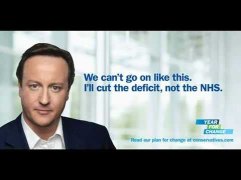
That last point hints at the real problem facing the NHS. Ultimately, its slow decay is only a visible symptom of a deeper malaise. And that malaise stems from a broken political system.hqdefault The Conservatives knew that the NHS was their weakness back in 2010, hence their much-mocked campaign slogan: “I’ll cut the deficit, not the NHS.” Yet now, the Health Secretary can wage war with the doctors’ union and incur the wrath of the vast majority of voters without any real political damage being done. The only thing that has really changed is the state of our politics.
Amol Rajan, the editor of the Independent, has written eloquently this week about how concerned we should be about the state of Britain’s democracy. It is a subject I have also touched on several times (here, here and here, for example). But Rajan does it better. In a tour de force finale, he invokes the “generation of men and women” who “often died young” in the name of power to the people, and concludes:

Barely two generations on, we are forfeiting [democracy] by sheer indolence, sleepwalking into the very tyranny from which they thought, and prayed, they had delivered us.

The anger on my Facebook timeline shows that politics can still rouse strong feelings in ordinary voters. In the case of the junior doctor contract, anger is arguably justified, although I wouldn’t personally consider the BMA the saintly trade union that others seem to. But none of this changes my view: anger is welcome, but it would be better directed not at the symptoms but at the failing political system that created politicians like Jeremy Hunt and public services like the NHS.
Why Nick Tyrone is wrong about First Past the Post

Nick Tyrone, formerly of the Electoral Reform Society and the Yes to AV campaign, has revealed his support for the First Past the Post voting system today. This is a pretty courageous move (in the Yes Minister sense) for someone with those associations and who is still a Liberal Democrat, as far as I’m aware.

So naturally I was intrigued to see someone of his stature within the Lib Dem/liberal community resile from electoral reform at a national level. He still supports PR for local government.

I was wondering whether he would make any new arguments for FPTP that I hadn’t already heard. But actually, he hasn’t. I don’t usually make a habit of fisking other people’s writing but on this occasion I have to make an exception.

His argument for retaining FPTP begins like this:

But at Westminster, I actually think First Past the Post has definite advantages. Relevant to the age we live in, it keeps extremism at bay. Some electoral reformers talk endlessly about how the Tories got a majority with only 37% of the vote. Yet, if we’d had a proportional system in place, the most likely government would have been a Tory-UKIP coalition, which would have had just over 50% of the nationwide vote together. I don’t see that as a step up myself, and many centre-left voters who automatically see PR as more progressive should have a long, hard think about DPM Farage.

Immediately there are a lot of problems. First of all, Nick says FPTP “keeps extremism at bay”. That’s a problematic statement both because it begs a question – namely, what constitutes extremism. Plenty of people might think the current government has an extreme agenda on the economy, or on intelligence and surveillance, for instance.

But more troublingly, it takes for granted the notion that the voting system we should use should have an in-built anti-extremism safety mechanism. In other words, we should rig our democracy to reduce the possibility of certain views being fully represented. That is, of course, the opposite of democracy.

Another problem: “the most likely government would have been a Tory-UKIP coalition”. This is based on the vote share those two parties received under FPTP. But you can’t extrapolate from vote shares under FPTP to a PR outcome; voting behaviour could change, possibly dramatically, with moderate parties like the Liberal Democrats likely to benefit from voters’ anti-extremist preferences.

But also this is just another version of “keeping extremism at bay”.  A genuine democracy sees the majority view represented. If the majority vote for parties that are considered extreme, then an extremist government is what we should get. I have no desire to see that outcome, but the possibility of its reality is in line with the principles I subscribe to as a democrat. I cannot abandon those principles for political expediency.

Another problem is that PR for Westminster can just sound like sour grapes. For instance, Caroline Lucas always going on about the Westminster voting system being “broken” or some other pejorative term. It feels a bit like, sorry to say, the Greens couldn’t break through under FPTP so now it’s time for a new voting system that will help them do better. Or then she talks about a Labour/Lib Dem/Green alliance. Putting aside the political realities standing in the way of that – if you want a “progressive majority” so badly, why don’t you just join Labour and fight for stuff inside of that party?

This isn’t an argument against PR, but against the Green Party. Unsurprisingly, I have some sympathy with it. I want my party to succeed under whatever voting system we have, and that’s why it’s not sensible to keep banging on about electoral reform as the central political issue facing the UK today (even though, in one sense, it is).

On the other hand, small parties are right to feel aggrieved at their lack of representation in Parliament. UKIP won a lot more votes than the Lib Dems in 2015; they have 1 seat to the Lib Dems’ 8. The Lib Dems won 24% to Labour’s 29% in 2010; they won just a fifth of the seats (57 against 258).

This is a fundamental injustice. It’s not about helping parties “do better”; it’s about recognising that they have broken through by winning votes, and that the system should reflect their success.

Finally, Nick turns to coalition government:

The last coalition may not have been to some tastes, but it was stable and it was effective at getting legislation passed. The Lib Dems thought if coalition could be shown to be functional over the course of a five year parliament, enough people would vote Lib Dem again in order to have another pluralist government. The Lib Dems were wrong about this, as May 2015 showed. And you can go on and on about tuition fees and what you see as the betrayals of the Lib Dems in government – you are only proving my point. The British people, and most pronouncedly in some ways now, those on the Left in Britain, are not prepared to accept coalition government. Given PR is almost guaranteed to produce coalition government in most instances, FPTP is the only way to go at Westminster level until the British public finds itself in love with coalitions (i.e. never).

This is a mis-diagnosis of the Lib Dems’ failure in 2015. The decision to go into coalition obviously lost the party a chunk of its support, but fundamentally our disastrous performance was about loss of trust. To say that that means the British people have rejected the idea of coalition itself is wrong.

The reality is that British voters are anti-government in whatever form it arises. A YouGov poll conducted in April 2015 showed that no form of government had a net positive reputation with voters. Even a Tory majority only scored -3. Moreover, there was some evidence in polling around the election to suggest that voters actually approved of the idea of the Lib Dems mitigating the other parties.

It is, in any case, impossible to extrapolate this kind of conclusion from election results – partly because FPTP itself does not tell us enough about voters’ preferences. Perhaps that is why Nick supported AV, a preferential (but not a proportional) system – because he himself recognised at one time that having the most possible information about what voters wants will create a better democracy.

All he needs to do now is recognise that seats should match votes – and he’ll have completed his journey from darkness to light.

Corbyn: that joke isn’t funny any more

Whatever hopes Jeremy Corbyn may have had for 2016, they have been summarily crushed within a week of all those pristine new calendars and diaries gaining their first entries.

The chaos surrounding the Labour leader’s so-called “reshuffle” – which has rather less resembled an orderly rearrangement of a pack of cards than a pack of tantruming toddlers running amok in a casino – has ensured that any semblance of calm he might have acquired over the Christmas break has evaporated.

All sorts of advice has been offered to Corbyn since he became leader of a party that, for sheer dysfunction and disunity, may now deserve to be preceded by “hen” – or the prefix of doom, as Bernard Black had it. But such advice is entirely useless. He could hire recently-Sirred Lynton Crosby himself, the doyen of Antipodean win-at-all-costs electioneering, and it would make no difference.

It has taken Corbyn fewer than four months to achieve total ignominy – an achievement that Ed Miliband arguably took a full five years over.

The Conservatives must be absolutely desperate to keep Corbyn where he is. They won the 2015 election having preached the importance of “security”. Now, despite oodles of real-world evidence showing that they couldn’t secure a padlock in a safe, the UK under their guardianship is being made to look like a combination of Fort Knox and Alcatraz guarded by the Avengers themselves when compared to Labour’s utter ineptitude.

I mentioned Lynton Crosby earlier. Knighting the man who ran the government’s election campaign should be an obvious warning sign that the government thinks it has carte blanche. And that’s not even taking into account his lobbying activity.

When the Prime Minister’s chief concern is his own party’s capacity to oppose him, it only goes to show that there is only one party he is seriously worried about.

When the Prime Minister thinks he can defenestrate the formerly-sacred principle of collective responsibility to allow his own Ministers to campaign against his government, it only proves one thing: he doesn’t see a threat coming from elsewhere.

When the Prime Minister says he will carry on in post even if he loses a referendum that defines Britain’s place in the world, it demonstrates arrogance – certainly – but also that his position is nigh impregnable.

UK politics would be hilarious right now, if it didn’t matter. But that joke isn’t funny any more. It’s too close to home, and it’s too near the bone.

Happy new year, Jeremy.

Today in “UK democracy”: government cuts funding for its opponents

From time to time the total inadequacy of our parliamentary democracy is brought starkly into view. Today is one of those occasions.

Can it possibly be anything other than deeply dangerous and anti-democratic for the ruling party to make decisions on the funding of opposition parties?

Yet that is exactly what George Osborne has just done. He is proposing to take away almost a fifth of taxpayer funding from Labour and other opposition parties.

Given Labour and the Lib Dems in particular rely heavily on so-called Short Money, this seems nakedly political, striking at the heart of the opposition’s ability to hold the executive to account.

From the Spending Review document, published earlier today by the Conservative Chancellor of the Exchequer:

The government has taken a series of steps to reduce the cost of politics, including cutting and freezing ministerial pay, abolishing pensions for councillors in England and legislating to reduce the size of the House of Commons. However, since 2010, there has been no contribution by political parties to tackling the deficit. Indeed, taxpayer-funded Short Money has risen year-on-year from £6.9 million in 2010-11 to £9.3 million in 2015-16. 108

Therefore, subject to confirmation by Parliament, the government proposes to reduce Short Money allocations by 19%, in line with the average savings made from unprotected Whitehall departments over this Spending Review. Allocations will then be frozen in cash terms for the rest of the Parliament, removing the automatic RPI indexation. Policy Development Grant allocations will also be reduced by a similar proportion, ensuring that political parties in receipt of taxpayer-funding contribute to the savings being asked of local and central government.


Chancellor, with these council tax rises you are really spoiling us!

Today’s lazy political journalism story is brought to you by the BBC.

Over the weekend, Auntie reported that George Osborne was “to allow council tax [to] rise to plug care funding gap”.

The story suggested that the Chancellor, in his beneficent majesty, would graciously allow local authorities to raise council tax by a whopping 2% to help cover a funding shortfall in adult social care.

Councils and private providers of social care are already in a pretty big hole due to the cuts to council budgets over the past few years, and this is about to be exacerbated by the introduction of Osborne’s feted new minimum wage.

The thing is – councils already have the power to raise council tax by (as near as dammit) 2%. In order to raise it higher than that they have to put on a costly local referendum, thanks to Eric Pickles, but 1.99% is fine.

So the story here is just that the Chancellor is not going to impose any more central control on a major aspect of local government finance.

I’m sure that will solve everything.

Terrorism is not the greatest current threat to the British way of life

It’s now almost eight months since the face of British politics was decisively altered. Yet the full impact of the UK’s 2015 general election has still to be understood by politicians, let alone the voting public.

You might think this is hyperbole. A lot of people said the same thing after the 2010 election, for instance, due to the apparent breakthrough of the Lib Dems as the third party – and the prospect of perpetual coalition government.

But my view is no exaggeration. The reality of the election is this: we have been left with a Conservative Party vulnerable only to its own hubris. The opposition is either disinterested, splintered, or simply invisible.

We are now in a situation where world events threaten to further diminish our ability to discern the dangers of our domestic political environment. The emphasis on responding to recent attacks is understandable, but not at the cost of allowing a majority government to do whatever it wants.

In the immediate aftermath of the election I retained some hope that with such a small majority, a combination of internal squabbling and a united opposition might force the Conservatives to veer away from Austerity Mk II. And for a brief moment in October, this looked like it could yet ensue.

Embankment.jpg

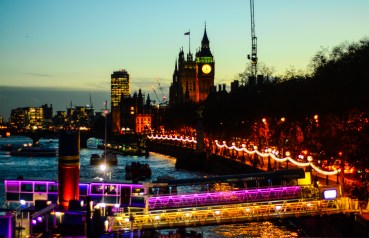
View of Westminster from Embankment Bridge

The tax credits issue threatened to throw some light on the punishing and unnecessary way in which George Osborne is planning to slash and burn the welfare state. Had Labour peers sided with their Lib Dem counterparts in the House of Lords, the government could have suffered a decisive defeat. But instead, Labour trimmed their sails just as the wind turned in their favour, adopting a halfway house position that gave Osborne breathing space to come up with a “solution” by the time of his Autumn Statement.

I confidently predict that that solution will be spun as a major climb down on his part, but will give almost no real relief to the people against whom the cuts were targeted.

Of course, since the Lords sent Osborne back to the drawing board, events have moved on rapidly. UK politics, like those of every other Western democracy, are currently dominated by questions of foreign policy, terrorism and conflict.

The irony of this should not be lost on anyone who witnessed as recently as April the major parties of a still-influential nation conniving to pretend that we are serenely unaffected by world events.

While of course we should take every sensible step to respond to terrorist attacks effectively – if, indeed, there is an effective response – the significance of recent events domestically is already plain. A ComRes poll released last night shows a remarkable 70% of voters agreeing with the statement: “We have to accept infringements of privacy on the internet for the sake of fighting terrorism”.

Theresa May has so far declined to force through her new surveillance measures despite this overwhelming public support and the best efforts of arch-authoritarian Andy Burnham to speed her up. But it is a matter of time.

Meanwhile, the same poll showed that public perceptions of Jeremy Corbyn are rapidly worsening in the wake of his post-Paris prevarication. A mere two months after he became leader, he now looks in serious danger of being toppled before next spring’s elections, with MPs and even Shadow Cabinet ministers lining up to criticise and undermine him.

People won’t necessarily thank me for talking about domestic politics in the context of the current debate around our response to Daesh. But it is unavoidably relevant. This Wednesday, George Osborne will be in the House of Commons to deliver his Autumn Statement and the results of his spending review.

His statement will have far more profound effects on our way of life than terrorist attacks ever could, even ones of the same shocking scale as Paris. As I write that sentence, I blanch at a comparison that seems extremely insensitive, but that is the reality we face.

Will Hutton – hardly a raving Marxist, but rather a mainstream, Keynesian social democratic economist who was strongly associated with New Labour – has an extremely powerful article in today’s Observer which urges us to weep for the country we live in. It details the hard facts of Osborne’s plans, and what they could mean. This is the “security” the Conservatives promised the nation in April and May:

the de facto wind-up of the Department for Business as a pro-active department, further shrinkage of the criminal justice system (mitigated by prison sell-offs), local government reduced to a husk and the knell of further education. Meanwhile, the cuts in welfare will hit the wellbeing of millions, including their children. Expect on top a firesale of government assets – from housing associations to Channel 4.

Terrorism is a serious and awful threat to our lives and our way of life. But my point here is that it is emphatically not the greatest threat. We should not – must not – allow attacks like those in Paris and Mali to distract us from what is being done by our own government in the name of “security” – whether economic or military.

In five years’ time, our government may well have helped to wipe Daesh off the face of the earth. I will be the first to celebrate that outcome. But unless there is a serious change in the way our government is scrutinised and held to account by our opposition parties, our media and, most of all, voters themselves, we can expect our country to have been irrevocably damaged in the meantime.

This process can and should start on Wednesday. George Osborne’s statement will be carefully stage managed. As in the summer Budget and as both he and David Cameron did at their party’s conference, he will take great pains to appear ever so reasonable, moderate, even centrist. He has been given space to do so, of course, by articles like Hutton’s (and like this), with their dire warnings of imminent doom.

The presentation will be serious, but with just the right amount of apparent backtracking, alongside some trademark difficult decisions and some patriotic purchases.

The question is whether we have yet learnt not to take him at his word.

“‘Tis your thoughts that now must deck our kings”: Henry V at the Barbican

The Royal Shakespeare Company’s production of Henry V, running at the Barbican till late January, is extremely timely, arriving on the 600th anniversary of the Battle of Agincourt.

Despite appearing slap bang in the middle of his career – written in 1599, Henry V was the 21st of Shakespeare’s (roughly) 42 plays, according to many modern chronologies – it is his most fully realised history play.

Appearing as the fourth in his second history tetralogy, encompassing Richard II and Henry IV (whom he covered in two parts), it is a sophisticated discussion of kingship, power and war that rewards close reading.


Not pro- or anti-war

In order to stage a successful production of Henry V, the most important factor is to acknowledge that it is not the jingoistic tub-thumper of myth.

The 1944 film, directed by and starring Laurence Olivier, and commissioned by the British government to boost morale, may well have been the first silver-screen adaptation of the Bard to achieve commercial success, but it was also really dreadful.

It’s dreadful not just because of the aforementioned tub-thumping jingoism, but also because it failed seriously to deal with the ambivalence and the nuance of Shakespeare’s portrayal of Henry himself.

Thankfully, Gregory Doran’s production at the Barbican avoids these major errors. Under Doran’s careful guidance, the RSC’s production is a play neither pro- or anti-war, but about going to war.


The play’s the thing

Some of the best moments are in the reappraisal of the famous speeches. In particular, the delivery of “once more unto the breach” – often portrayed, such as in Ken Branagh’s 1989 film, as a rallying cry – is made into a real argument.

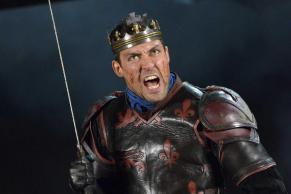
Here, Henry is a small man on an empty stage, pleading with his “troops” – actually the audience – for one more push. Alex Hassell is excellent here, managing to infuse the high-flown rhetoric with real uncertainty.

Hassell also excels during the subsequent speech to the governor of Harfleur. Again, this is lent extra weight through the direction; the governor is on stage, but not visible, for most of the speech, in which the English king lists a range of gruesome threats should surrender not ensue.

These threats are some of the most problematic in Shakespeare’s depiction – infanticide and rape feature heavily. Even allowing for historical context Henry’s determination is fearsome, bordering on criminal. But delivering the speech to an empty stage is a masterstroke – giving the scene an air of uncertainty, allowing the king to say things that he might draw back from addressing to someone’s face.

henry-v-sep15-review

Alex Hassell as Henry V

Hassell is less impressive in the genuinely tub-thumping speeches. His rather reedy voice is well-suited to quieter passages – his tour through the camp on the eve of battle is a real highlight – but lacks the power for the “band of brothers” call to arms as Agincourt dawns.

The actual staging is rather bare, but it is enlivened by excellent lighting, including a very clever method that can create the appearance of different structures, as well as weather conditions – the “rain” during the battle was particularly impressive. Two elevated walkways at stage right and left enable some interesting positioning, and give the play its crowning moment of pathos, when a kind of celestial choir (including some of those killed in battle) join to sing the Te Deum as Henry realises he has won the day.

Other highlights included Oliver Ford Davies as a witty and occasionally grumpy Chorus. The understanding of how Shakespeare played with his audience – sometimes teasing, sometimes demanding – was clear and these moments, which can often drag, zipped by. I would say that the humorous scenes were done very well overall, too; if Branagh’s film had a failing it was that those bits were sometimes ponderous. Here, Doran has huge fun with the Welsh/Irish/Scottish dialogue, getting big laughs from Fluellen’s leek obsession among other things.


Warring like it’s 1599

What could be more fitting than a play addressing complex issues of leadership and conflict in November 2015?

The reason I keep coming back to Henry V as one of my favourite Shakespeare plays is because it is unafraid to address those enormous questions that echo down through history.

Serious study of the play would benefit all aspiring and current leaders, whether of a small number of people or of entire nations. Prime Ministers and Presidents across the world are currently wrestling with a rapidly worsening security situation that for the first time in my remembered life threatens to end up in a return to global conflict between large nations.

The self-awareness that Henry shows, his grasp of history and his understanding of his enemy, are all attributes that some of our esteemed leaders would do well to emulate.

And for us, the audience, understanding the weight of the decisions such leaders have to make is vital. We will be better citizens and better critics of foreign policy if we take seriously the real difficulty of such responsibility. As Shakespeare himself put it, “uneasy lies the head that wears a crown”. Our modern leaders do not always wear the crown, but this week of all weeks they are just as susceptible to the stress and loss of sleep that accompanies events of great moment.

If David Cameron really wants an “assault on poverty”, he could always try giving the poor more money

One of the striking things about David Cameron’s much admired speech yesterday was the emphasis on the concept of “equality”. This was very much at the heart of the rhetoric: he promised to “finish the fight for real equality” and even went so far as to say that “you cannot have true opportunity without equality”.

Equality is undoubtedly a powerful concept. But it’s become a political cipher. And I mean that word in every sense: when a politician uses the word “equality”, it is simultaneously devoid of any meaning at all; a code that the politician’s supporters instinctively feel they can crack; and a method of concealment. The same can be said of words like “values”, “progressive” or – most problematically for my party – “liberal”.

Cameron himself acknowledged that he believes in equality of opportunity, but not equality of outcome. This is what enables the key elision in the most “centre left” section of his speech: that an “assault on poverty” is the same thing as tackling “the root causes of poverty”. If you read this part of the speech carefully, you can actually see the ghost of Lewis Carroll’s Humpty Dumpty hovering smugly in the background:

Central to [tackling big social problems] is an all-out assault on poverty.

Conservatives understand that if we’re serious about solving the problem, we need to tackle the root causes of poverty.

Homes where no-one works; children growing up in chaos; addiction, mental health problems, abuse, family breakdown.

This is a revealing passage. To put it in the language of sophisticated political commentary, Cameron has things completely arse about face. Look at what he is saying: that the reason people are poor is because they have dysfunctional lives, health problems, or are actually guilty of criminal behaviour.

I’ll repeat that: to David Cameron, the root causes of poverty are the terrible decisions that people choose to make about their own lives.

Poor children in olden times. They probably should have worked harder tbh.

Or to boil it down still further: if you’re poor, it’s probably because you live a life that led inexorably to that outcome.

If you really believe this – as David Cameron claims to – then equality of opportunity is a meaningless concept; there’s no use trying to magically turn such bad, stupid, dangerous people into good, intelligent, virtuous ones.

Of course, he’s wrong. The root cause of poverty is – surprise! – people not having enough money.

This might be a shocking revelation to some people. But it seems pretty obvious to me. People who have enough money aren’t poor. People who don’t have enough money do tend to be. QED.

Now, you might say that’s far too simple, and I’m making the same mistake that Cameron has, but from the other side. But if I’m right, then there would be lots of evidence suggesting that if you give poor people more money, their lives get better, yes?

And it just so happens that there is. In lots of countries across the world, governments have found – ASTONISHINGLY – that if you directly transfer cash into the hands of poor people, they… spend it on things that will make their lives better. And no, I don’t mean cheap booze and cigarettes – or even beer and bingo.

There are articles and studies which explore this phenomenon further.

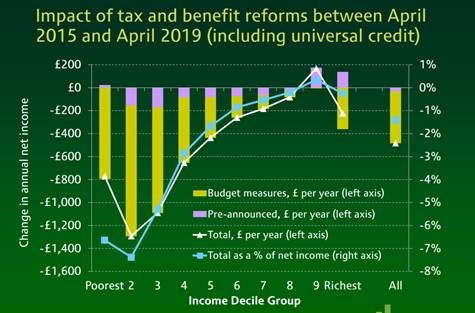
But obviously, David Cameron isn’t just intending not to give the poor people in the UK more money. He’s already announced, via his sidekick George Osborne, that poor people will actually have money taken away from them. I’ve used this graph before, but it is kind of essential to understand the impact of the Budget on the UK population:

The Institute of Fiscal Studies, which produced the above graph, has also undertaken further analysis since then. This reaffirmed the fact that people on low incomes will be far worse off, even when you include all the random policies Cameron claims will alleviate the impact.

If David Cameron really wants an assault on poverty, and to ensure that there is equality – even just equality of opportunity – he could start by reversing or at least drastically reducing his tax credit cuts. But more importantly, his entire government needs to start seeing poverty the right way round, rather than from a position some way through and to the right of the looking glass.

Today we left reality behind and entered David Cameron’s fantasy world

To read the breathless commentary of moderate pundits as David Cameron delivered his speech to Conservative Party Conference today, you would be forgiven for thinking that Cameron had announced a reversal of tax credit cuts, a real living wage, the abandonment of his ridiculous net migration target, and the implementation of a land value tax, all while wrapped in a red flag and doing that thing Tony Blair used to do with his hands.

(You know the one: when he used to make a fist and then stick his thumb out, creating an effect both dominant and approachable at once. Clinton used to do it, too.)

What we actually saw, of course, was nothing more than a good PR man playing to type. Cameron and Osborne have both quickly realised the opportunity offered to the Conservative Party by the election of Jeremy Corbyn: namely, power almost in perpetuity, provided the Tories don’t tip too far to the right in the eyes of typical voters.

Anchoring the party to the perceived “centre ground” has been both men’s transparent aim at this party conference, even if Theresa May seems to think now is the time to veer off into the xenophobic weeds in an attempt to bolster her leadership credentials. It is a simple continuation of the strategy already employed by the Chancellor at the Budget. As I wrote then, a bit angrily:

Aided and abetted by a supine media and an opposition that isn’t there, he is using the Conservatives’ new political capital to carry forward at a far greater speed his vision for Britain.

If anything, since then the nation’s media has become even more supine; in fact, today they were simply prostrate. Damningly, this is particularly true of centre-left commentators who, far from praising Cameron for his rhetoric, should be pointing out at every opportunity the lies he is spinning. Instead, they were busy saying things like:

The worst example of this was Ian Dunt’s unusually ill-judged article on Politics.co.uk, in which he argued that Cameron’s speech was proof of the positive impact of Jeremy Corbyn on British politics. He went so far as to compare Corbyn’s success in dragging Cameron to the left to Margaret Thatcher’s greatest achievement, New Labour.

Every time this happens, it simply gives the Conservatives more breathing space to implement even more right wing policies. The natural consequence of this fawning media reaction will manifest itself in policies that are not just distant from the greater Britain Cameron claimed to dream of today, but that actively undermine the possibility of a more moderate, compassionate society ever coming into being.

Come November 25th, the Spending Review and the Autumn Statement will reveal just how far from reality Cameron’s fantastical rhetoric took everyone today. It won’t be breathless or exciting; it won’t be surprising or brilliant. Instead, it will be presented as an inevitability: “tough decisions none of us came into politics to make”. But that will be a lie.

Cameron’s Greater Britain won’t be moderate. It won’t be compassionate. It won’t increase equality or reduce poverty. As I wrote after the Budget:

It is a country gripped by greed, selfishness and suspicion. It is a country where the poorest are expected to fend for themselves and where the wealthiest are enabled and encouraged to hoard their riches.

If people as smart and influential as those I’ve mentioned in this article are genuinely being taken in, there is little hope for the rest of us.

British politics is now just a question of maths and time

I consider Matthew Parris to be the finest columnist in the UK, and today’s article on Labour is one of his best.

He suggests that Jeremy Corbyn’s victory is an opportunity – rather than a defeat – for the centre left: a “gift”. He paints a painfully accurate picture of what is likely to happen to the Labour Party now that Corbyn is in place:

The party may (as I suggest) go out with a bang. Equally likely, some residual instinct for self-preservation will kick in, they’ll defenestrate Corbyn, and replace him with a less astringent nonentity, capable of papering over the cracks.

In which case the party will go out with a whimper, on a long, gentle amble into that good night: drifting on towards the next election – and the next, and the next – never winning, forever compromising, softly losing support in a sort of quarter-century slow puncture…

Arguing that Labour is the same old beast it’s always been, and that three election victories under Tony Blair couldn’t reshape its identity, he pleads with Labour’s moderates to abandon the brand. There is a fairly strong hint at the end of the piece that he is suggesting they should either start a new party in the mould of the SDP or join another party.

Parris is a liberal Tory who, it is fairly clear, harbours some fairly warm feelings towards my own party and to whom the coalition government was probably close to the ideal blend of ideas and policies. So I think it’s quite clear which home he is envisaging for these liberal Labourites. In any case, the same argument is being made on a regular basis by senior Lib Dems too.

Unfortunately, it’s completely unrealistic.

Labour MPs bow to no one in their tribalism. Even now most Labour people – even the moderates – are still pretty pleased about what happened to the Liberal Democrats in the general election: this is despite the fact that if the Conservatives had not won seven seats as a result of Lib Dem voters switching to Labour, they would not have a majority in the Commons.

More importantly, it’s a simple question of mathematics. If to be in politics is to exercise power, then Labour moderates have two ways of doing so. One is to stay where they are, grit their teeth and hope for the best: that somehow, in two or three years, the tide of left-wing support will ebb as quickly as it flooded in, and their party will allow someone “sensible” to take over in time to avoid total destruction in 2020. The other is simply to join the Conservatives, on the basis that they are closer to people like George Osborne than to Jeremy Corbyn.

Neither scenario is at all plausible.

If there were a third party with, say, 50-60 MPs, around 20% of the vote and a relationship with the electorate that hadn’t entirely curdled into a poisonous mess, things might be different. But there isn’t.

For the UK opposition (which doesn’t include the SNP, a party so obsessed with its own nationalism that it may as well be given the opportunity to hang itself at this point), politics is now simply a waiting game. We must wait for the Conservatives to make some kind of mistake; to get so complacent that they try to do something so utterly insane that even voters who believe in their competence wake up to their fallibility.

It might take a very long time, and our country will almost certainly be a very different place – a poorer, harsher, more insular place – at the end of it.