Lenine is a Brazilian musician who, were there any justice, would be as well known across the world as any American or British singer/songwriter.
One of the best things about Lenine’s music is the way it blends traditional Brazilian forms with Western alternative influences. If only Anglophones were more receptive to lyrics sung in other tongues, they would find him incredibly accessible, but also noticeably innovative and markedly different.
My favourite song by him is Hoje Eu Quero Sair Só. This was on his first solo album, released in 1997, but still getting heavy airplay when I moved to Brazil as a 12 year old in early 2000.
Brazilian music is memorable on its own terms, but its effortless, relaxed sound often enables it to act as a suitable vehicle for lyrics that are sophisticated, emotional and surprisingly direct.
This song is a particularly good example of that phenomenon. It slinks up on you, driven by an acoustic guitar playing a repetitive set of chords in typical post-bossa nova style. If you listen carefully, that guitar is at the centre of the whole song and creates its insistent sound, even when all the bells and whistles of the (very late 90s) production have been added in.
And insistent is the right word for the lyrics as well. Lenine manages to create a sound in this song that exactly matches the desire expressed by its title (“Today I want to go out alone”). The lyrics tell the story of a relationship in which the war between intimacy and liberty is raging.
If you want to follow me, it’s not secure
You don’t want to lock me in a dark room
Sometimes it feels like we got tied up in knots
Today I want to go out alone
You won’t hit me at point-blank range
Come here, let me go, kiss me
Sometimes it feels like we got tied up in knots
Today I want to go out alone
This is a rough translation of the first couple of verses. As with many Portuguese phrases, the English language isn’t actually sufficient to capture the nuances; for example, I’ve chosen “tied up in knots” as a colloquial translation of “as vezes parece até que a gente deu nó”, but by doing so I’ve made it sound more negative than it seems intended to be in the song.
The sense of the song is deeply conflicted. The singer is expressing a need to go out alone where “alone” very definitely means “lacking another”. But he also keeps saying he’ll be back before long.
And then there’s the double-edged phrase “Vai ver se eu tô lá na esquina”. Literally this means “go and see if I’m on the corner”, but in Portuguese it’s a dismissive phrase which basically means “get lost”. Again, though, in this song it’s spun around or at least made more ambivalent by the following phrase “devo estar” – “I must be”.
The way the music is sinuously wrapped around this ambivalence, creating that great sub-tropical night-time feeling that embodies uncertainty, stillness, and the moonlight that calls you to the solitary street, makes this one of the greatest achievements of Lenine’s career and one of the finest introductions I can imagine to “MPB” – Musica Popular Brasileira.
Usain Bolt has just deservedly won the 100m World Championship for a third time, having beaten Justin Gatlin on the line by a thousandth of a second. It was a superb race, full of needle and bite.
Bolt showed himself to be every inch the legend he is by overcoming Gatlin’s far superior form and his own shaky performance in the qualifying rounds, epitomised by this morning’s semi-final in which he basically had to start again about 35 metres in after coming close to falling.
Unfortunately a great race between two supreme competitors was marred by commentators’ insistence on making it about the reputation of the sport. Gatlin is very much the pantomime villain in the eyes of the athletics community, having come back from a four-year ban for taking testosterone.
Steve Cram’s ludicrously overblown commentary on the final epitomised this. As Bolt crossed the finish line and began to cavort as is his wont, Cram went so far as to say that the Jamaican “may have saved his sport”.
My own view on this is likely to be unpopular. But it seems fairly clear to me that one race – however cathartic the result – does nothing to address the fundamental issue here. The problem is that once you introduce prohibition, people will inevitably seek ways around that prohibition. It is what human beings do.
In the world of elite athletics, where sportspeople are focused on doing everything they can to gain a tiny competitive advantage, it is little wonder that every so often -probably more often than anyone cares to admit, and certainly more often than the authorities are able to spot – someone finds a new way to cheat.
The answer is to recognise that “performance enhancement” is the essence of what it means to be an elite athlete. The Olympic motto, “Citius, Altius, Fortius” – faster, higher, stronger – is the simplest formulation of that credo.
A truly liberal solution to the problem of drugs in sport would simply be to treat athletes like adults. They take risks with their own bodies all the time in an effort to improve themselves. The wonders of biomedical science are brought to bear on them; in many ways they are lab rats masquerading as entertainers. So why are we so squeamish about what they choose to put in their bodies?
Clearly there should be safeguards, particularly for athletes on the cusp of adulthood who may be put under too much pressure. No one wants a return to an era when hundreds of athletes were routinely and indiscriminately doped for the glory of the Soviet state. So you might have to tighten competition rules to prevent the occasional precocious teenager from having too great an incentive to take too big a risk.
Some might also say that it would give too great an advantage to the wealthier nations or athletes, who are able to access and develop more expensive treatments and drugs. But let’s get real. If that’s a problem, it already exists. If you’re at the top of a sport it means you have the best of everything – nutrition, training, accommodation, and the rest. It seems unlikely to me that in a World Championship final such as the one run today, there is a major difference between the financial support each athlete in the race receives.
The only other objection that I can see is moral. It’s in the semantics of the debate, this, and probably the biggest barrier to my suggestion ever becoming a reality. People love to throw around words like “clean”, “pure”, “unimpeachable”, and the rest. The response to the race today sounded more like a Daily Mail article than anything else – pious and moralistic, damning of an athlete in Gatlin whose only current crime is to have had the guts to return to the sport, as he is perfectly entitled to do under current rules.
But if you’re not going to open up athletics completely to all of the technological and biomedical innovation and ingenuity humanity can muster, and you’re not going to ban people for life when they take drugs, you should probably stop whinging or suggesting that the whole sport is somehow under threat when an athlete of Gatlin’s calibre comes close to winning a major championship.
It’s time to treat athletes and sports fans alike as adults.
Few people will know that the Prime Minister’s Office issues a daily Points of Light award. The awards are designed to reward exceptional acts of community service or volunteering. Some of the people granted awards certainly represent the very best of philanthropic achievement and endeavour.
The phrase “Points of Light” is a direct quote from George H. W. Bush (right), who first used it when accepting his nomination as the 1988 Republican presidential candidate. His speechwriters were attempting to capture the idea of the American community as
a brilliant diversity spread like stars, like a thousand points of light in a broad and peaceful sky.
In the speech, this undeniably powerful image is immediately followed by a hard-edged passage on social policy, in which inter alia Bush issues his infamous pledge “read my lips: no new taxes”; sings the praises of capital punishment; and demands “zero tolerance” for drug dealers.
To me, the phrase has always seemed backward. Light itself is reliant on darkness in order to create a contrast. The use of the phrase in the speech makes that reliance explicit: these “points of light” are stars. To take the phrase literally, it suggests a predominantly dark environment.
In other words, Bush’s phrase – with its rhetorical intention to create a sense of hope – actually implied the opposite.
Bush went on to win the Presidency. He repeated the “thousand points of light” phrase in his inaugural address. He also wanted a “kinder and gentler nation” – a soundbite that quickly turned sour.
A month later, Neil Young performed a new song live for the first time. It was called “Rockin’ in the Free World”, and it was released on record in November 1989.**
A victim of circumstance, Young’s song would quickly become associated with the fall of communism and the break-up of the Soviet Union. But his poetry had a very different aim. The song was, and remains, a caustic assessment of Bush’s administration: its three verses seethe with ambivalence and anger about the state of American society and the country’s influence in the world – then at its absolute peak.
In the third verse, Young takes direct aim at the emptiness and hypocrisy of political rhetoric:
We got a thousand points of light for the homeless man
We got a kinder, gentler machine gun hand
In two sentences Young demolishes Bush’s insubstantial posturing. The first contrasts the hopey-changey rhetoric of “a thousand points of light” with the darkness that consumes millions of lives. The second mocks “kinder, gentler” by raising the spectre of Bush’s own history as CIA head and Iran/Contra collaborator – not to mention the wider US foreign policy escapades which, in the first verse, had left Young singing “don’t feel like Satan – but I am to them”.
But Young doesn’t stop there. The third verse takes in the US citizen-as-consumer, decrying “department stores and toilet paper/styrofoam boxes for the ozone layer”. He then goes on:
Got a man of the people says keep hope alive
And here is the sting in the tail. “Keep hope alive” was Jesse Jackson’s campaign slogan when running for the Democratic presidential nomination in 1988. The mocking tag “man of the people” shows just what Young thinks of it. Against a Republican candidate basing his campaign on shallow rhetoric, the American left in the late 1980s could muster nothing but equally vacuous slogans.
David Cameron’s “Big Society” was an attempt to find another way to say the same thing. Steve Hilton, for a while the Prime Minister’s Director of Strategy, used to be fond of wearing a tee-shirt that said “Big Society Not Big Government” (see example, right).
The idea presented to us was that as the bloated state got out of the way, it would be replaced by a more active and philanthropic civic society. But as this 2013 demolition of the policy’s pretended principles argued, it was a mere cipher, making room for the same traditional – and inadequate – paternalism.
No wonder it was quietly abandoned.
Nowadays, in the UK in 2015, the Conservative government so lacks ways to veil its continued campaign to unpick a comprehensive state-funded social security system that it is content simply to recycle Bush’s sloganeering. So it doles out daily Points of Light awards.
I do not suggest that the people receiving such awards are undeserving. Their work is valuable and, in many ways, increasingly so. But like the inexorable rise of food banks run by volunteers, the gaps opening up in our society are too wide for them to fill. They are sailors using tiny buckets to bail out a sinking ship as the icy ocean waters begin to freeze their blood.
Here is the nub of the matter: we live in dangerous times. We live in an era when the government is able to pass “reforms” to the social insurance system we have without a shred of opposition from, well, the official opposition. We live in a corrosive atmosphere where the foreigner is increasingly regarded not merely with suspicion but with outright hatred.
And the UK left is about to elect someone whose ability to hammer out an alternative is seriously questionable. In short, they’re going to elect a “man of the people” who says “keep hope alive”, but whose version of hope is as relevant as George H. W. Bush is now. A man who says on becoming leader he will apologise for a war that happened so long ago that the gap between it and today is already as long as the gap between it and the war that preceded it.
When people see that this “man of the people” is nothing more than a decent human being trapped in a vice of his own devising, slowly squeezed to death by a combination of a totally idealistic left and a resistant right, they will turn elsewhere. They will look for other populist movements. They will look for other plain talkers. And most of all, they will want someone whose politics match their fears.
Meanwhile those same fears will be amplified, by degrees and by stealth, by the government, which will chart a course that, by comparison, seems all moderation and good sense.
Got fuel to burn. Got roads to drive.
Keep on rockin’ in the free world.*
*The total usurpation of this song was completed recently by Donald Trump’s unauthorised decision to use it when announcing his candidacy for the Republican presidential nomination. The wheel turns.
**The performance Neil Young gave of RITFW on Saturday Night Live in 1989 is justly regarded as one of the greatest live TV performances of all time. He worked himself into a frenzy backstage in order to mimic the feeling of performing an encore after a full two hour set. And it shows.
Today Julia Hartley-Brewer has an article on Capx urging non-aligned voters who care about their country to join Labour as a supporter in order to back “Anyone But Corbyn” – the so-called ABC campaign.
To be honest I’d always thought Hartley-Brewer was a signed-up Tory. She frequently writes for the Telegraph, used to broadcast on LBC, and Capx is one of the trendiest new right-wing blogger hang-outs going, often populated by other strongly Conservative commentators such as Iain Martin and Daniel Hannan. To be fair to her, she claims in the article never to have been a member of a political party, so let’s give her the benefit of the doubt.
The problem with her article is that it fails on its own terms. Her argument is that a government should be scared of the alternative; that without a functioning opposition, we risk losing democracy itself. She claims to object to “power with no end in sight”.
If that’s the case, why doesn’t she try pointing out that the “majority” government we have was elected on just 36.9% of the vote? If the seats in the Commons reflected anything like the reality of how ballots were cast, we would not be in a position where the choice of opposition leader would determine the result of the next general election (as she seems to believe) – because we wouldn’t have a system where the winner takes all.
The temptation is to think that Hartley-Brewer, far from cherishing democracy and wanting to protect and extend it, is more interested in shutting down legitimate debate by preventing the rise of a genuinely left-wing Labour leader. If that’s the case, very well, but don’t use the figleaf of a commitment to democracy to cover it up – say so.
Attempting to understand the mindset of the typical voter is a fool’s game. The last election bequeathed upon us a huge amount of commentary attempting to explain why it was that the Tories had such success – not least from the Tory high command itself, hastily moving to pretend that a majority government had always been on the cards.
The Labour leadership campaign, meanwhile, has seen much of the same discussion, with the Blairite remnant arguing for soft Toryism on the basis of nothing much at all, and the Corbynite insurgency cherishing the fond myth that if only some more non-voters would vote, a reheated and insubstantial version of soggy socialism will take the country by storm.
I don’t pretend to know the “average voter”. I do know my fair share of people who, when it comes to elections, um and ah over which party merits an X by its name. For such people, elections are not about neatly packaged sets of policies, or coherent ideologies. They are instead typically about the feeling that each party gives them, along with perhaps one or two ideas that have burst through the media ether and captured their hearts.
Usually the former trumps the latter, though, and I think a cold hard look at the facts of the 2015 general election bears that out. The Tories aren’t in power because of their frankly creepy “plan for every stage of your life“. They’re in power because voters in the right places looked at them and thought “well, they’ve been in government for five years and we haven’t been forced into indentured servitude yet, and by the way have you SEEN the other guy?”
The central question of British politics right now is not who leads Labour (or even the Liberal Democrats). The question is how far the Conservatives can push their ideological agenda along before voters start to object to it. At the moment they are making excellent progress on this; George Osborne’s summer budget was the supreme example of a viciously regressive set of policies made palatable by sugary, centrist presentation.
The spending review that looms in November will be another step down this road. But as others have written, there will have to come a point during this Parliament where the impact of spending restraint on public services begins to bite in places where it has yet to do so. As the Financial Times’ recent superlative in-depth exploration of austerity Britain pointed out, the cuts to date have fallen on services catering to marginalised social groups which are almost invisible in political terms, having no natural media presence or support behind them.
But this can’t continue. If the Conservatives continue to cut public spending “until the pips squeak”, sooner or later the “typical voter” will start to see, or rather feel, it.
It’s my hunch that adult social care might well be the tipping point. This is an area that doesn’t just affect a small group of marginalised people but an increasing number of relatively well-off and middle class voters. Crucially, it’s not just the service users that are affected by the strain on the system, but their children and sometimes their grandchildren too may well be of voting age.
The story in the Observer this weekend, in which the Chief Inspector of Adult Social Care warned over the bad care being created through systemic pressure, could be the starting point. But in order for this to change voters’ minds in the longer term, the effects of such bad care will need to be seen far and wide. It’s not until such stories start appearing in the Daily Mail or the Daily Express that they are really taking root.
The Conservatives have nurtured a reputation for competence which is actually a mask for an ideology that simply doesn’t want well-funded public services. Unfortunately, they are so good at wearing that mask that the underlying ideology can’t be challenged on its own terms. So instead the task must be to challenge and destroy that reputation for competence. When that has been done, then, and only then, will voters seek a true alternative.
The lesson for Labour and the Lib Dems? Make arguments personal. Go and find people whose lives are being ruined by this government. Make sure they are people with whom the “typical voter” can easily identify, and tell their stories. Don’t talk in abstract technocratic terms about “integration” and “personalisation”.
It’s the sort of thing the Tories do. It’s part of how they win. They are past masters at manipulation and fabricated fear. The only way to beat them is to play them at their own game. If you can make people feel the true impact of a regressive government, you can earn the right to offer them something else. But you have to earn it.
I have a tenuous relationship with Bjork’s music. She released her ninth studio album, Vulnicura, meaning “Cure for Wounds” in January this year, and it’s certainly not a summery listen, but I’ve come to it late, so you’ll have to deal with this somewhat unseasonal choice.
The album is as conceptual as any of her previous work, dealing with the break-up of her long-term relationship with artist Matthew Barney. It is a work of deep emotional honesty and can be quite difficult to listen to at points. Thankfully the pain of the lyrics is matched by the beauty of the music, which signals at least a partial return to the “beats and strings” approach of her early albums, Debut and especially 1997’s Homogenic, which remains my favourite of hers.
(Incidentally, 1997 was probably the greatest single year for music since the 1970s.)
“Black Lake” is the dark heart of the album, which is so precisely linked to real-life events that many of the tracks have subtitles detailing the number of months before or after the break-up. 10 minutes long, it was written “two months after”, and bears the hallmarks of the stuttering beginnings of understanding and anger that swirl around at such a time.
The singer herself professes to be embarrassed by the track, and this quote sums up perfectly the feeling it creates as you listen to it:
It’s like, when you’re trying to express something and you sort of start, but then nothing comes out. You can maybe utter five words and then you’re just stuck in the pain. And the chords in-between, they sort of represent that. […] We called them “the freezes,” these moments between the verses. They’re longer than the verses, actually. It’s just that one emotion when you’re stuck. It is hard, but it’s also the only way to escape the pain, just going back and having another go, trying to make another verse.
The film made to accompany the music is also characteristically beautiful and overwrought in equal measure.
I have never been attracted to the Labour Party because all I have ever known of it has been a consistent attempt to match the Conservatives for authoritarianism. Latterly that has also developed into an attempt to match the Conservatives for “economic competence”, which actually appears to be a euphemism for regressive policies designed to force people off “welfare”, even if it pushes them into penury.
Today Harriet Harman has confirmed the next phase of this process, by agreeing that Labour, at least under her interim leadership, will not seek to oppose one of the most offensive policies in the Budget: the limitation of child tax credits to the first two children. This is effectively social engineering, attempting to force families who rely on social security payments to change their family planning arrangements – a kind of two-child policy, albeit one that is much softer than its equivalent in China. Labour are also supporting the reduction of the household benefit cap to £20,000 a year outside London.
Harman’s reasoning for this is insidious and reveals the muddled thinking at the top of Labour. She’s argued that her party cannot do “blanket opposition” because it lost the election. This is terrifying and undemocratic, implying that whoever wins the election has been given a blanket mandate. As Nelson Jones, who blogs at Heresy Corner, put it:
Harman's comments are rather chilling in a democracy. "We won't stand up for what we believe in because the other party won the election."
As bad as this is her other argument, though, which is based on the comments of people who were jealous of the state support given to other people. Look at her views here:
“When I was going around the country on the pink (election) bus, talking specifically to women, so often they would say we’ve got one child, we’d really love to have another but we just can’t afford it, what with our homes not big enough and the childcare is too expensive,” she said.
“They’re working hard and they feel it’s unfair on other people that they can have bigger families that they would love to have if they were in the position to do that. We have to listen to that.”
This is just total capitulation to the Tories’ divide-and-rule tactics. The answer to voters with views like that is certainly to listen, but it is also to argue back; to say that the reason these people have state support is because the way our economy is structured means that they are working, but do not earn enough to live without that top up from the state. What we need to do is change the way people are employed and paid, not set different groups against each other. That is difficult and requires careful thought, but you can’t just give up.
Predictably, Labour leadership candidates are lining up to oppose Harman’s views – so far I think Andy Burnham, Yvette Cooper and Jeremy Corbyn have come out against her remarks. For now, though, Harman is vacating the reasonable centre ground of British politics, leaving space open for a party that is able to offer the right balance between work and a proper safety net.
People have different ideas on what makes public services viable. If you take the purpose of services such as the NHS to be meeting the needs of the population, then it is almost inevitable that, at times, they will run at a deficit, as government funding lags demand. This is certainly true of many NHS Trusts at the present time; financial difficulty is not a proxy for the quality of services being delivered.
The corollary in the private sector is that super profits are no indication of a quality service either. It is often assumed that the more profit a company makes, the better the service or product that it delivers or makes – but this is lazy thinking. Key public services operate based on need, regardless of the profitability or convenience of the service user; private companies have no such restriction, and can pick and choose their market based on the path of least resistance.
A consequence of this difference is that public services need staffing levels that match the amount of need – at all times. This is incredibly difficult to achieve. If we think of health, especially, there are some trends you can predict, such as increased incidence of colds and flu in the winter months, but there will always be significant variation from month to month and year to year.
One way to deal with this is through temporary staff, but it’s difficult to get enough people in that way, and it’s hard to obtain that kind of flexibility without taking a hit on quality, which is why hospitals increasingly turn to private agencies to plug the gaps. This, in turn, leads Ministers to panic over what they see as an excessive reliance on temporary agencies. Yet this expense is a symptom, not the ultimate cause. The ultimate cause – whether in the NHS or in other parts of the public sector, including social care, schools and social work – is a chronic recruitment shortage.
Politically it’s undesirable for Ministers to recognise this fact. But a fact it is. Partly, it’s due to ineffective recruitment programmes, which often require a financial commitment on the part of the student. But a lot of it is also due to dismal retention rates. Take teachers, for example: reports in the past 18 months suggest that two-fifths of teachers leave the profession within five years.
Why is it so difficult to keep public sector workers in their posts? Because the work is hard, the pay is low, and the pressure placed upon you by the government is well nigh unbearable. The workload experienced by state school teachers is well-documented, but nowhere is the stress of the public sector more obvious than in social work. Here is a profession which requires you to work closely in some really difficult, knotty situations: where hard cases lead to unfair dismissals and obscenely large compensation payouts. As soon as you attempt to intervene, you are accused of nanny statism. And now the government is moving to stigmatise the profession further by criminalising service failure – threatening to throw ordinary social workers, teachers and councillors in jail for wilful neglect. Who would want to have to find the balance between these two extremes?
So even before Wednesday’s Budget we had the makings of a perfect storm on public sector recruitment: an existing shortage, a crunch in recruitment, and terrible retention rates. I could also talk about the effect of the government’s attempts to shut down immigration routes, which are also highly relevant. But the Budget adds to this storm in two highly significant ways.
The first is the “national living wage”. Amid the furore over the terminology and the impact on business, it’s been little noted that one of the main sectors most affected by a higher minimum wage will be social care. Of course, most providers of social care are private businesses, but they are paid by the public sector, and the providers find it incredibly difficult to find and retain good staff. Social care services spend about 60% of their entire budget on staff, so an above-inflation increase to the minimum wage creates huge cost pressures. And this is against a backdrop of continuing punitive cuts on local government – the purchaser of such services – which has meant a long-term freeze on the fees paid to providers. It’s entirely possible that smaller social care providers will be forced out of the market as a result of this Budget, at a time when demand for such services is inexorably rising. Sooner or later, the system is going to fail, we will see more incidents of bad care or even abuse, and the victims will be vulnerable elderly people.
The second, which is more widespread, is the decision to cap public sector pay rises at 1% for the next four years. This is an outrageous decision that, at a stroke, makes recruitment far more difficult. Ok, at the moment inflation is running low enough that 1% would actually be a real terms pay increase; but compare that to average weekly earnings to April 2015, which rose at a rate of 2.7%. It’s important to remember that the public sector has to compete with the private sector for staff: what’s the incentive for an energetic, ambitious, skilled young person to go into teaching or care or nursing here? At some point, “vocation” is not sufficient to bridge these gaps – and the situation we’re in suggests we reached that point some time ago, so we don’t need to widen the gap further.
So what’s the result of all of this? It seems clear that the current government has taken the decision that vital public services can be allowed slowly to dwindle and die, to be replaced by a patchwork of private sector providers motivated by profit. The contradictory motives and ethe involved in this approach will eventually be unsustainable.
It would take a huge commitment of political and financial capital to turn this listing ship around.
CORRECTION: This article previously mentioned a claim by the Association of Teachers and Lecturers that 40% of newly qualified teachers were not in teaching after a year. This has been comprehensively debunked, for example here, so I have removed the reference. I’m grateful to Damian Counsell for pointing out the error.
This week marks the 20th anniversary of the worst genocide in Europe since the Second World War. The death toll in Srebrenica was more than 8,000 Bosniak men and boys, gunned down by the Bosnian Serbs under the generalship of Ratko Mladic, who remains on trial at the International Criminal Tribunal for the former Yugoslavia for crimes against humanity, including the events at Srebrenica.
I have been fascinated and disturbed by the genocide at Srebrenica since my childhood. One of my earliest memories is watching news footage of the Bosnian war and the Siege of Sarajevo; I have a vivid memory of the smoke and flames billowing from the Parliament building, and the distinctive yellow block of the Holiday Inn, where most of the foreign media were based during the war.
Srebrenica has special resonance for me partly because of a song written by the American folk singer, Tom Paxton. We used to listen to Tom Paxton a lot when I was a child, and many of his songs were cutesy throwaways: zany treats like “Goin’ to the Zoo” and funny little vignettes such as “I Don’t Want a Bunny Wunny“, a musing upon President Jimmy Carter’s encounter with a vicious killer rabbit.
On the Road from Srebrenica, though, is Paxton at his most visceral, serious and human; a mournful retelling of the brutal violence meted out, through a series of disturbing images. The lyrics zoom in and out from individuals among the panicked thousands fleeing; they dwell on the sickening efficacy of the murder; they provide that mixture of awful dread and just enough humanity (in the carefully hopeful third verse) to sock you in the gut every time you listen to it.
Ok, it has some poetic licence: Paxton seems obsessed with the idea that the weather was cold, even though the massacre occurred in July, and Eastern European countries including Bosnia are generally very warm at that time of year. But the essential truth of the song can’t be denied.
It is a fitting memorial for one of the greatest blots on human history. It still astonishes me that this occurred in my lifetime.
If you hadn’t guessed from the title of this post, I vehemently disagree with Peter’s view. My central point in our discussion was that Osborne’s brilliance involves shifting the political centre to the right, through appropriating previously left-wing policies such as the “living wage” to suit his own ends.
When you consider that Osborne and Cameron gained their initial political colours during the period when Tony Blair was in the ascendant, this becomes unsurprising: they are merely doing what he did, but the other way round, and arguably more successfully.
Of course, they also have it easier, because Blair’s political strategy was based on using market mechanisms to reform public services. In purely economic terms, he didn’t even begin to challenge Thatcherite laissez-faire mores. So when the Tories came to power in 2010, they had little to unravel from that perspective – and they also had the perfect excuse (a massive financial crisis and an unsustainable deficit) to begin to reshape the size and role of the state as they wished.
Now Osborne can take that one stage further without the Liberal Democrats to restrain his more extreme ambitions. His goal is to create a new political economy: one in which the state is no longer involved in attempting to solve material and social inequality of outcome or, indeed, opportunity.
To take a charitable view, we might entertain the idea that he really is committed to a “high wage, low tax, low welfare economy” – but this would be to ignore the reality of the Budget he has just announced. The facts are that the policies announced yesterday achieve neither of the first two concepts:
The “high wage” aspect is a smokescreen. No government can raise wages simply by saying so, and the impact of the change is, by confusing the mandate of the Low Pay Commission, to politicise a system that previously worked well. The Office of Budget Responsibility is also clear in its analysis that the “national living wage” will create more unemployment, and will cost the economy money. Given that this is the only policy in the Budget that attempts to create “high wages” – we can chalk it up as a failure.
What about low tax? Well, it’s now clear that this Budget is a net revenue raiser, with £25 billion of tax cuts playing off against £47 billion of tax increases. So purely on that alone, he has failed. Moreover, the tax cuts he did announce were focused on the top end of the income and wealth distribution. Obviously the inheritance tax cut only benefits those who are sitting (or more accurately whose parents are sitting) on high-value estates. But the increase to the 40% income tax threshold also only benefits those who earn more than £43,000, while it is understood these days that increases to the basic income tax threshold also disproportionately benefit those on higher incomes.
No, in actual fact, the only portion of Osborne’s mantra that was successfully implemented was the “low welfare” bit. Here, it is true, the Chancellor has delivered in spades. The extent of the cuts and freezes to working-age benefits is breathtaking; more breathtaking still is how they are targeted on the poorest people in society, especially those in low-paid jobs.
The overall distributional impact analysis was, curiously, left out of the official Budget documents published by the Treasury. This was unusual, as in previous years (including all the years of the Coalition 2010-2015) the Red Book has included charts showing the impact of policy changes on each income decile group. This time, though, it has been left to others to demonstrate the starkly regressive – punitive – effect of George Osborne’s approach. This chart from the IFS speaks volumes:
Here you can see not only that the poorest third of the population lose at least £800 per year, but that the ninth richest decile is actually enriched by this Budget.
What’s the point of all this? It’s to show that the Chancellor has entirely failed to deliver a Budget consistent with his own stated aim – a “high wage, low tax, low welfare” economy.
If he were serious about the first bit, he would have used yesterday’s statement to use the proceeds of higher taxation (or even of lower welfare) to put money behind upskilling the workforce. But he didn’t.
If he were serious about the second bit, he wouldn’t have raised an extra £47 billion by disproportionately penalising small businesses through changes to dividend taxation, or by absurdly forcing a carbon tax on companies that buy renewable energy.
The only serious bit was the third bit, and that is because his central political aim is to strip away the support that keeps poor people afloat.
The genius of the Chancellor is to use sweeteners and carefully crafted soundbites to appear reasonable, even centrist. Yesterday was perhaps his most successful attempt yet. Aided and abetted by a supine media and an opposition that isn’t there, he is using the Conservatives’ new political capital to carry forward at a far greater speed his vision for Britain. It is a country gripped by greed, selfishness and suspicion. It is a country where the poorest are expected to fend for themselves and where the wealthiest are enabled and encouraged to hoard their riches.
The most worrying aspect for the Liberal Democrats about all of this is that we are in no position to oppose Osborne. It is only now, after our electoral destruction, that the full scale of our strategic failure in government is becoming apparent.
As Stephen Tall’s excellent but depressing blog today suggests, if our party were still in Coalition, we’d have cheered this Budget.
 Steve Cram’s ludicrously overblown commentary on the final epitomised this. As Bolt crossed the finish line and began to cavort as is his wont, Cram went so far as to say that the Jamaican “may have saved his sport”.
 The phrase “Points of Light” is a direct quote from George H. W. Bush (right), who first used it when accepting his nomination as the 1988 Republican presidential candidate. His speechwriters were attempting to capture the idea of the American community as
 A victim of circumstance, Young’s song would quickly become associated with the fall of communism and the break-up of the Soviet Union. But his poetry had a very different aim. The song was, and remains, a caustic assessment of Bush’s administration: its three verses seethe with ambivalence and anger about the state of American society and the country’s influence in the world – then at its absolute peak.
 David Cameron’s “Big Society” was an attempt to find another way to say the same thing. Steve Hilton, for a while the Prime Minister’s Director of Strategy, used to be fond of wearing a tee-shirt that said “Big Society Not Big Government” (see example, right).
 And the UK left is about to elect someone whose ability to hammer out an alternative is seriously questionable. In short, they’re going to elect a “man of the people” who says “keep hope alive”, but whose version of hope is as relevant as George H. W. Bush is now. A man who says on becoming leader he will
  thought Hartley-Brewer was a signed-up Tory. She frequently writes for the Telegraph, used to broadcast on LBC, and Capx is one of the trendiest new right-wing blogger hang-outs going, often populated by other strongly Conservative commentators such as Iain Martin and Daniel Hannan. To be fair to her, she claims in the article never to have been a member of a political party, so let’s give her the benefit of the doubt.
 The spending review that looms in November will be another step down this road. But as others have written, there will have to come a point during this Parliament where the impact of spending restraint on public services begins to bite in places where it has yet to do so. As the Financial Times’ recent
  eadership, will not seek to oppose one of the most offensive policies in the Budget: the limitation of child tax credits to the first two children. This is effectively social engineering, attempting to force families who rely on social security payments to change their family planning arrangements – a kind of two-child policy, albeit one that is much softer than its equivalent in China. Labour are also supporting the reduction of the household benefit cap to £20,000 a year outside London.
 Politically it’s undesirable for Ministers to recognise this fact. But a fact it is. Partly, it’s due to ineffective recruitment programmes, which often require a financial commitment on the part of the student. But a lot of it is also due to dismal retention rates. Take teachers, for example: reports in the past 18 months suggest that
  One of my earliest memories is watching news footage of the Bosnian war and the Siege of Sarajevo; I have a vivid memory of the smoke and flames billowing from the Parliament building, and the distinctive yellow block of the Holiday Inn, where most of the foreign media were based during the war.
 Now Osborne can take that one stage further without the Liberal Democrats to restrain his more extreme ambitions. His goal is to create a new political economy: one in which the state is no longer involved in attempting to solve material and social inequality of outcome or, indeed, opportunity.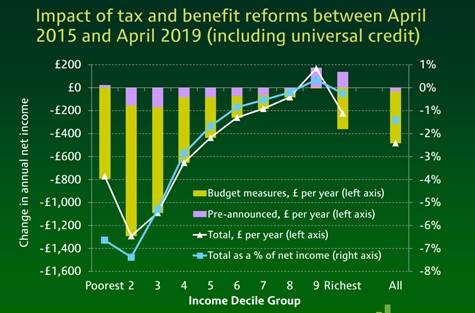
 Never Cruel Nor Cowardly