Shock as Middle-Aged, Middle Class Men Dress Age-Appropriately

A bit (OK, a lot) of silliness yesterday, as it was pointed that Nick Clegg, David Cameron and Ed Miliband were all wearing similar clothes. Buzzfeed even ran an entire article on it even though the “news” had already been discussed extensively on Twitter.

Dan Hodges even tweeted this earlier today:

I was talking to a friend yesterday who suggested that politics is the most cynical profession out there. Tweets like Dan’s above are partly to blame for that view. The implication is that these middle-class men of a certain age have carefully considered whether teaming a light blue collared shirt with a navy blue jumper will position them correctly in the eyes of the voting public.

Nick wears it best though, yeah

Steve Parsons / PA Wire/Press Association Images

This was also taken to ludicrous extremes by Howard Jacobson’s somewhat turgid and exhausting discussion of George Osborne’s trousers on A Point of View today.

It’s unsurprising that we want to relate absolutely everything back to ourselves – after all, we’d like to think the world revolves around us as voters. But isn’t it far more likely that these men barely gave a second thought to their wardrobe when they got up yesterday? They wear these clothes because they’re what men like them wear, especially in early spring in 2015. What’s the alternative? A suit at all times, even on a Bank Holiday weekend? A V-neck tee and skinny jeans? They’re in their mid-to-late 40s, for goodness’ sake.

How about we ignore what politicians are wearing and listen to what they’re saying? And that applies not just to these men but also (and in particular) to the tiresome, predictable misogyny meted out to the likes of Nicola Sturgeon and Leanne Wood.

Only the Lib Dems are listening to the NHS

Most of the political debate around the NHS, certainly in the Leaders’ Debate on Thursday night, has focused on who should deliver NHS services. In particular, the anti-austerity parties, as well as the Labour Party, are extremely sceptical about what they call “privatisation” – the provision of NHS services by private companies.

This is ironic, as the NHS itself has made its position very clear. Before Christmas, a document called the Five Year Forward View (FYFV) was published. This was really a manifesto for the future of the NHS – written by senior management figures within NHS England, the central body that controls much of the NHS’ commissioning and funding decisions, and based upon the collective and specialist knowledge of the NHS itself. The NHS FYFV doesn’t talk much about “privatisation”. Instead, it focuses on what are really the biggest challenges for the NHS. To summarise:

  • The NHS needs to focus much more on prevention and public health – this is aimed at stopping a sharply rising burden of avoidable illness
  • The NHS needs to move towards new models of integrated care – at the moment there’s a big divide in lots of places between GP surgeries and hospitals, between hospitals and care homes, and between physical and mental health

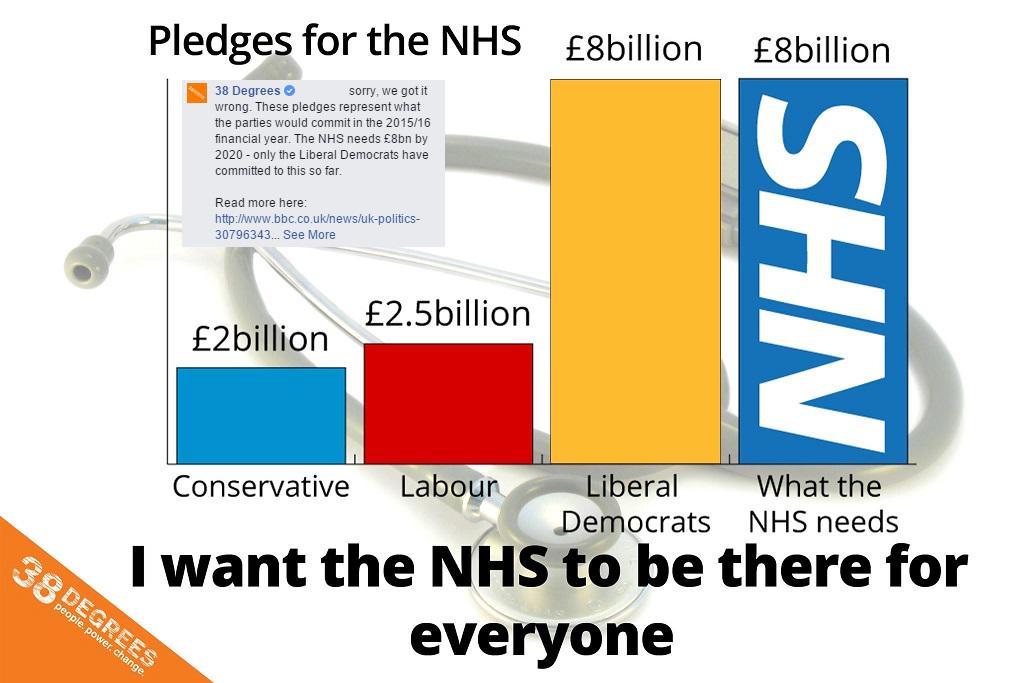
The FYFV also made it clear that without making the right sort of changes, and assuming funding levels stay broadly as they are over the next five years, the NHS will be under-funded to the tune of around £30 billion by 2020. Given the entire NHS budget currently stands at around £100 billion, that constitutes what some might call an existential threat. The document sets out various ways to meet that challenge. In short, NHS England thinks that with the right service reform and the introduction of these new models of care, it can make efficiency gains representing about £22 billion of the shortfall.

But that still leaves £8 billion of extra funding. And this is where the political parties come in. They are the ones who make the decisions about where tax is spent on our public services. They have a choice as to whether they will listen to the NHS itself – which is effectively lobbying them to put in this extra funding – or whether they will prioritise other public services, or indeed whether they will simply spend less overall and give people more tax cuts instead.

This graph shows how the parties are planning to fund the NHS over the next five years:

(h/t Paul Valentine @iampav)

As you can see, only one of the major parties has actually listened to the NHS itself when it comes to the vital funding needed to maintain “a comprehensive taxfunded NHS”.

If you believe in the value of such an NHS – one that doesn’t need to go cap in hand to private companies to provide vital services, or force people to rely on private medical insurance, or introduce new or increased charges for GP appointments or minor surgical treatment or prescriptions – then there’s only one choice at this election. The Liberal Democrats are the only party that truly wants to protect the NHS.

Jenni Russell on Nick Clegg

The Times’ political coverage is, I tend to think, the best of the non-specialist newspapers (I’m not including the FT in that group). Ok, it’s a Murdoch paper and inevitably leans centre-right – but it’s no Daily Telegraph. It’s also distinguished by having a stable of extremely sensible commentators and columnists. These come from disparate backgrounds but are chiefly notable for their fair-mindedness.

Chris Furlong/Getty Images

So it is that last night’s debate receives a wide range of different reviews on the Times website. In particular I was struck by Jenni Russell’s piece which culminated thus:

For me, Clegg was the underrated performer of the night. I didn’t share in the Cleggmania of five years ago; but tonight I was impressed by the sheer determined decency of the man who has seen his party immolated in the cause of the coalition, but who is still positive and hopeful in telling people that only the Lib Dems can moderate Tory cuts and Labour overspends.

You may not agree with him, but you ought to salute his spirit.

This very much reflects my own view of the Lib Dem leader. After five years of coalition government I can’t help but admire his tenacity, bravery and optimism, whatever I might feel about some of the decisions he’s made on behalf of the Lib Dems.

Classic satire The Day Today once again overtaken by real events

The Guardian has a story today on DIY dentistry, which is apparently on the rise in the UK due to cost and lack of access in certain parts of the country:

In a country that prides itself on free healthcare, DIY dentistry is an almost Victorian notion of hardship. But poverty and inequality – and the increasing stigma attached to both – are blocking access to healthcare for the poorest people in the UK, and grim tales of a black economy are on the rise.

The cost of dental treatment on the NHS is relatively uncontroversial, politically, which has always surprised me. Compare, for example, the outcry whenever a kite is flown for GP appointment charges.

The current government claims it has increased access, and is in the middle of piloting a new dental contract that would refocus attention on hard-to-treat patients and particularly those from poorer backgrounds. But it’s easier said than done.

Of course, Chris Morris was onto this more than two decades ago, with this classic clip from The Day Today:

Two Worlds Collide in the #LeadersDebate

I’ve never really been the kind of person to give an instant reaction to anything. My sister is the complete opposite: you could tell us both the same news and you’d know instantly what her response was – usually incoherent rage righteous anger. I’m usually slow to react, either because I’m still trying to get my head around what I’ve heard, or because I am feeling conflicted about it, or because I want to maintain my lofty rationality in the face of base emotion. (That last one’s more theoretical.)

So having watched the heptagonal #leadersdebate, aired on ITV last night, I’ve taken some time to chew over what I saw. I am sure that there has been no end of commentary, and with the Easter Bank Holiday weekend now in full swing, most politically-engaged people will have read much of it already.

Certainly on Twitter and Facebook there seems to have been some consensus emerging. A lot of this was around the fact that Nigel Farage is a horrible individual. I’m not sure how surprising that is, but it certainly bodes well for any future EU referendum that even naturally right-wing voters (and I know and love quite a few of those) simply find him appalling.

(h/t Financial Times)

The other thing that came out strongly from many of the responses I saw was that it was great to see some diversity in the debate. Certainly it was good to have some balance, although it was painfully white. I always flinch a bit, too, at the idea that it’s in any way surprising when politicians of the calibre and experience of Nicola Sturgeon – who is, after all, the current First Minister of Scotland, and who has been in government for longer than anyone else on the panel – prove themselves articulate and competent.

My main reaction to the debate was that it really was a collision of worlds. There were two separate conversations running simultaneously, each only including some of the leaders. Nigel Farage was of course having his own personal conversation, aimed at people who already think he is Churchill reborn.

On one hand, you had a serious-minded, largely managerial discussion between David Cameron, Nick Clegg and Ed Miliband on the realities of government and policy. This was painfully familiar to those of us who live and breathe the political process, but would still have been relatively new to most voters. I thought all three leaders did well in stating their case, but that as in 2010, Clegg did a particularly effective job in demonstrating that there is a middle ground to be found. It felt far less fresh this time around – and will have a drastically diminished impact on the Lib Dems’ fortunes – but it will still have an impact on the ground.

On the other hand, you had a far more free-wheeling conversation led by the anti-austerity brigade. Sturgeon in particular took on Clegg’s 2010 mantle as the sharp, intelligent and human alternative to “politics as usual”. She also capitalised well on the other leaders’ ignorance of Scottish politics, which enabled her to make bold assertions on issues like privatisation and funding of the Scottish NHS that, on closer inspection, simply fall apart.

To me, the big tactical question of the evening was whether Ed Miliband would get dragged into that debate. He will be pleased today that he largely avoided it. The decision he had to make was whether to present himself as the main challenger to David Cameron, or to spend his time fending off attacks from smaller parties. He chose the former – correctly – and emerged unscathed.

What does it all mean? In terms of this campaign, very little. None of the parties will receive a major boost in the polls as a result of the debate. While Sturgeon probably “won”, as far as anyone could, her party has already risen as high as it can in Scotland alone.

Does a seven-strong debate change the view people have of general elections? Perhaps. But until we have seven parties capable of having one conversation, not much will change.

Compassion – the Missing Ingredient in our Politics

Yesterday I posted about the lack of ambition in UK politics. Of course, it’s not quite true to suggest that many of the parties or their leaders have low expectations. What I’m saying is that their ambition is limited only to the immediate, and based almost completely on the interests of a subset rather than of everyone.

My suggestion is that if you want people to be interested in the political process, this is shortsighted. It’s well known that people, and often those who don’t vote regularly, care and sometimes passionately about many inherently political issues. They just don’t link the issues to the people and institutions who are supposed to be sorting those issues out. Or worse, they do link them but think those people and institutions simply don’t understand or don’t care.

Political parties occasionally fixate on the gaps in their own reputation that seem to prevent their reaching more people. David Cameron famously attempted to “modernise” the Conservative Party when he became leader. More recently, Michael Gove (of all people) gave a speech in which he suggested that the Tories should be the “warriors for the dispossessed”, mirroring the “Good Right” movement spearheaded by the prolific and tireless Tim Montgomerie, the Times columnist and one-man Conservative think tank. Even Boris Johnson has been making noises about more moral politics in the press this week.

It’s easy to be cynical about such rhetoric. In Gove’s and Johnson’s case, it’s easy to see why they might be hammering out a slightly different message from their party’s suffocating but undeniably disciplined economic message. What’s perhaps harder is to recognise that they might be on to something. They may have stumbled upon the most important missing ingredient in our politics.

That ingredient is compassion. This is often thought of merely in terms of sympathy for those who are suffering, but it goes beyond that. Compassion is to suffer with others, with an accompanying desire to alleviate the suffering.

Our politics sorely lack compassion. I was struck reading this horrific BBC article about just one failed asylum seeker in London how a senior politician would naturally react (in public) to such a story. They would make some sympathetic noises, certainly; perhaps even offer to write a letter to the relevant Minister. They might refer back to policy decisions their party had taken, especially ones that were tangentially related, in an attempt to suggest that they have helped the person by association. But they’d also be cautious – perhaps suggesting that it’s important to look after the vulnerable but at the same time referring to the equal or greater need to ensure that only people who have a legitimate reason to be in the UK should stay here.

This is particularly true of the way we treat immigrants and asylum seekers. A friend of mine commented on a recent Facebook post:

I really think the way we treat immigrants as a society is the issue above all others that we’ll look back on and say ‘how did we ever think this was acceptable?’

But it applies, probably just as much, to the vulnerable in our own society – a group that encompasses the homeless and disenfranchised, disabled people, sexual or lifestyle non-conformists, low-skilled workers, even people in receipt of any kind of benefits other than pensions.

Most of all, in order to be truly compassionate, you have to be able to feel compassion for people that you might at best ignore. That’s what our politicians are particularly bad at. We’ve moved so far away from that as a society that it’s now not only acceptable to ignore such people; it’s part of political campaigning actively to sneer at them, to judge them and to punish them.

I’m not suggesting this is easy. But if politicians truly believe in public service and the public good, they must start to grapple with this – and how to reintroduce compassion into what they and their parties say and do.

Labour To Ban Non-Exploitative Zero-Hours Contracts

Yes, that headline is correct. The BBC reports:

Ed Miliband said a future Labour government would guarantee zero-hours workers the right to a formal contract after 12 weeks of regular work, a move which he said would reduce economic insecurity but which was criticised by employers.

<snip>

The proposal, which has been welcomed by the unions, would see an end to more than 90% of existing zero-hours contracts, Labour said.

Let’s walk through this step by step.

  1. Zero-hours contracts are something generally used by businesses that need flexible staffing in order to deal with demand which can peak and trough quite radically. Think, for instance, of restaurants or cinemas.
  2. When people talk about “exploitative zero-hours contracts”, they are generally referring to the fact that workers on such contracts have very little certainty over when they will be working. They’re powerless, at the beck and call of their employer.
  3. The reality about zero-hours contracts is far from conclusive. For one thing, there are no clear statistics on the number of people who are on them, according to the ONS.
  4. However, that’s a little by the by. If what Labour is looking for is increased certainty for workers, then by all means, this is an area to consider making policy in.
  5. You would think, if exploitation is centred on uncertainty, that the policy response would be to limit that. In this case, the best way of doing so would appear to be to require employers to set a minimum number of guaranteed, regular hours on each contract. The downside of this is likely to be less opportunities for prospective employees – but it would improve conditions for existing employees (at least, the ones that are kept on) by giving them guaranteed and regular hours.
  6. As it turns out, Labour has decided to do exactly the opposite by proposing to ban only those zero-hours contracts where employees have been working guaranteed and regular hours. In other words, by the commonly used definition, they intend to ban non-exploitative zero-hours contracts.
  7. The meaning of this is that only exploitative zero-hours contracts will remain legal.

This is another example of a party making policy based on a set of assumptions that are at best hazy and, at worst, lazy. It may well be that there is a problem with some types of zero-hours contracts. It was commonly agreed, for example, that forcing employees to sign such contracts exclusively (i.e. barring themselves from working anywhere else) was wrong. It has subsequently been banned by the coalition government.

However, Labour’s proposal simply generates heat rather than light, and actually runs the risk of employers putting more, rather than fewer, people on such contracts. Why? Because if you’re an employer, and you know you’ll have to give someone a regular contract if they work regular hours, you might just decide to employ more people and give them sporadic work to do. Some jobs can’t be done that way – sure – but a lot can. And we should bear in mind that zero-hours contracts only represent around 2% of the overall workforce anyway.

All in all, for a policy that has dominated Labour’s third day of the election campaign, this is a bit of a dog. I’m tempted to suggest they spent zero hours – or at least very few – thinking it through.

Lack of Ambition is Killing Politics

Aside from the usual April Fool’s Day tomfoolery, today has begun with debate over a letter from 100 prominent business people to the Times warning about the impact of a Labour government on the economy.

As one would expect, the responses to such a letter are tiresome and predictable.

The Tories crow over their economic record and the support they have “won” from people who would probably always have voted for them.

Labour point out that these people would always have supported the Tories and anyway they are all tax avoiders.

A few Lib Dems pipe up to suggest that if the past five years have gone well, maybe it’s something to do with Vince Cable being Business Secretary. They are ignored.

It’s all pretty unexciting and unedifying. But it does serve as a good illustration of the problem of lack of ambition. This is a big part of what is crippling our politics, and why voters often don’t care, or say all the parties are the same.

A voter (even one like me) looks at this letter and goes through this kind of thought process.

So the Tories are content to rely on the support of their core voters at this election? That’s fine if you’re a wealthy businessman, or looking to become one, but what about me? I’ve got nothing in common with people who work in glass towers. I’m not sure I want to vote for a party that so transparently values such people higher than the rest of us.

What about Labour? They don’t seem interested at all in addressing what these people are saying. Their argument amounts to “well, we could never have reached them anyway, so why bother?” I’m not sure I want to vote for a party that isn’t willing to appeal to voters that aren’t a natural fit.

Hmm. Anyone else about?

This isn’t to suggest that other parties don’t fall into this trap. I’m a member of the Lib Dems partly because I believe they want to represent and speak for the whole of society. The party has very few vested interests.

But the party has suffered in government from the same affliction that affects the larger parties. The campaign this time around is based on warnings about the other two and what they would do on their own. That’s fine as far as it goes – some might say it’s even a necessary part of modern politics – but it’s hardly ambitious or visionary. For the fictional voter above, it gives nothing to grab on to.

If parties genuinely want to avoid a further haemorrhage of political support to the fringes and backwaters of nationalism and xenophobia, they must address their own lack of ambition. It’s highly ironic that their desperation to hold on to power blinds them to this greater and more strategic need.

On Sincerity

I often lament the fact that I have grown up as part of the most ironic generation of all time. The so-called “millennials” are surely characterised most of all by their sub-absurdist approach to everything, whether it is in trivial matters of appearance or in serious matters of the heart or of the head.

As Stewart Lee once put it in If You Prefer a Milder Comedian Please Ask For One (not verbatim, so apologies if this is inaccurate), the last taboo in comedy is someone on stage “attempting to do something sincerely and well”. He says this as he prepares to exorcise the villainy of advertising by playing his favourite song, Galway Girl, which was ruined in and by a well known cider advert.

I often think he’s bang on the money. It’s not just comedy though. It’s the whole of life. People find Lee divisive because he stands outside comedy even as he participates in it. Yet that is how people of my age and younger seem to deal with everything, especially the things that truly matter.

As someone who aspires to be a creative person from time to time, I find this crippling. The self-consciousness that characterises modern life in the UK is suffocating. The temptation to laugh at oneself, let alone at others, is overwhelming. Yet this must be resisted, even in the face of accusations of pretension. The reality is that not everything is pretentious or inherently insincere, however much our absurdist culture likes to think so.

What prompted this? The experience of listening to Sufjan Stevens’ masterpiece, released today, entitled Carrie & Lowell.

An album about grieving his estranged mother, it strikes at the heart of what it means to be human and to be a complex man of sometimes tenuous faith. It is painfully honest, so much so that at times one feels almost as if one is intruding on something that should have remained private.

I wrote this about it elsewhere:

This album is triumphant: bleak, gut-wrenchingly honest, full of grief and doubt, but at the same time strangely resolute. When I hear it, I don’t want him – or anyone – to have experienced the incidents, situations and emotions that formed him into the person that made this record. But at the same time, it’s quite easily the best record he’s ever made, and probably the best record he’ll ever make. He must feel extremely equivocal about having created it (something that’s apparent in the interviews he’s been doing around the album, but also in some of the moments on the album itself, like the exhausted exhalation at the end of John My Beloved).

It’s times like these that you realise what inferior art is for; to give creations like these the backdrop they deserve, like a diamond on a black velvet display board.

It is not enough to live vicariously through the sincerity – the bravery – of others. Those people who are willing to put their heads above the parapet in creative or cultural terms, and get shot at for their trouble, are meant to inspire us. Ultimately they should challenge those of us who are lazy enough to believe that it’s ok merely to snipe at others and wear a mask ourselves. To my shame, that has described me for most of my life.

I don’t want to do it any more.

A Further Thought on #LabourMugs

Over the weekend, there was discussion of a certain product being offered on the Labour Party website. Specifically, it was a mug in glorious Fabian red, for the princely sum of £5, bearing the words of Labour’s fourth most important policy (if we are to assume that their pledge card is ranked in order of priority): “Controls on Immigration”.

Labour’s now infamous mug

Various people, including me, commented on the unpleasantness of the mug itself. This then led of course to further discussion of the pledge, and the fact that it is a marker for quite how far the Labour Party is prepared to go in abandoning any pretence of liberalism, or, indeed, “solidarity” that extends beyond the UK’s borders. A final irony is that the other four pledges Labour are making are heavily reliant on continuing high levels of migration, so that the UK can get the workers it needs. After all, as we know, migrants (especially those from the EU) have a far more positive impact on the UK’s fiscal state than UK-born citizens.

Of course, there has been a backlash to the criticism, although it’s been relatively muted. Ed Balls has been out and about defending the policy (and the mug) today, although other senior members of the Labour Shadow Cabinet have indicated their displeasure at the merchandise.

I’ve noticed that some of the backlash has been based on the same lie as the policy itself. The very phrase “controls on immigration”, of course, implies that at the moment we don’t have any. This has been reflected in the response by some people to the Twitterati’s anger: Hugo Rifkind, for example, asking Julian Huppert whether the Lib Dem position was “that there should be no controls on immigration”. I’ve seen other people asking broadly the same question; does opposing “controls on immigration” mean supporting “open borders”?

Quite obviously, this isn’t the case. The Lib Dems are of course the only major party in the UK as a whole to talk positively about immigration on a regular basis. But that doesn’t mean that the party supports open borders. For example, in government, we have been attempting to reintroduce exit checks despite the Home Office’s incompetence and intransigence.

But the wider point is more important still. What Labour are doing is simply capitulation. They have thrown in the towel and gone along with the pervasive lie that claims the UK is open to the elements and all sorts of nefarious types have come in to ruin things. This is the lie perpetrated most effectively by UKIP, and before them, the BNP.

We are now living in a country where the three parties polling highest are willing to blame our problems on immigrants. And it’s so uncontroversial that they can sell cheap tat telling you so. It’s a suggestion beloved of such people that we haven’t had a debate about immigration, but the truth is they don’t want one. Because everything’s simpler when you can blame it on someone else.